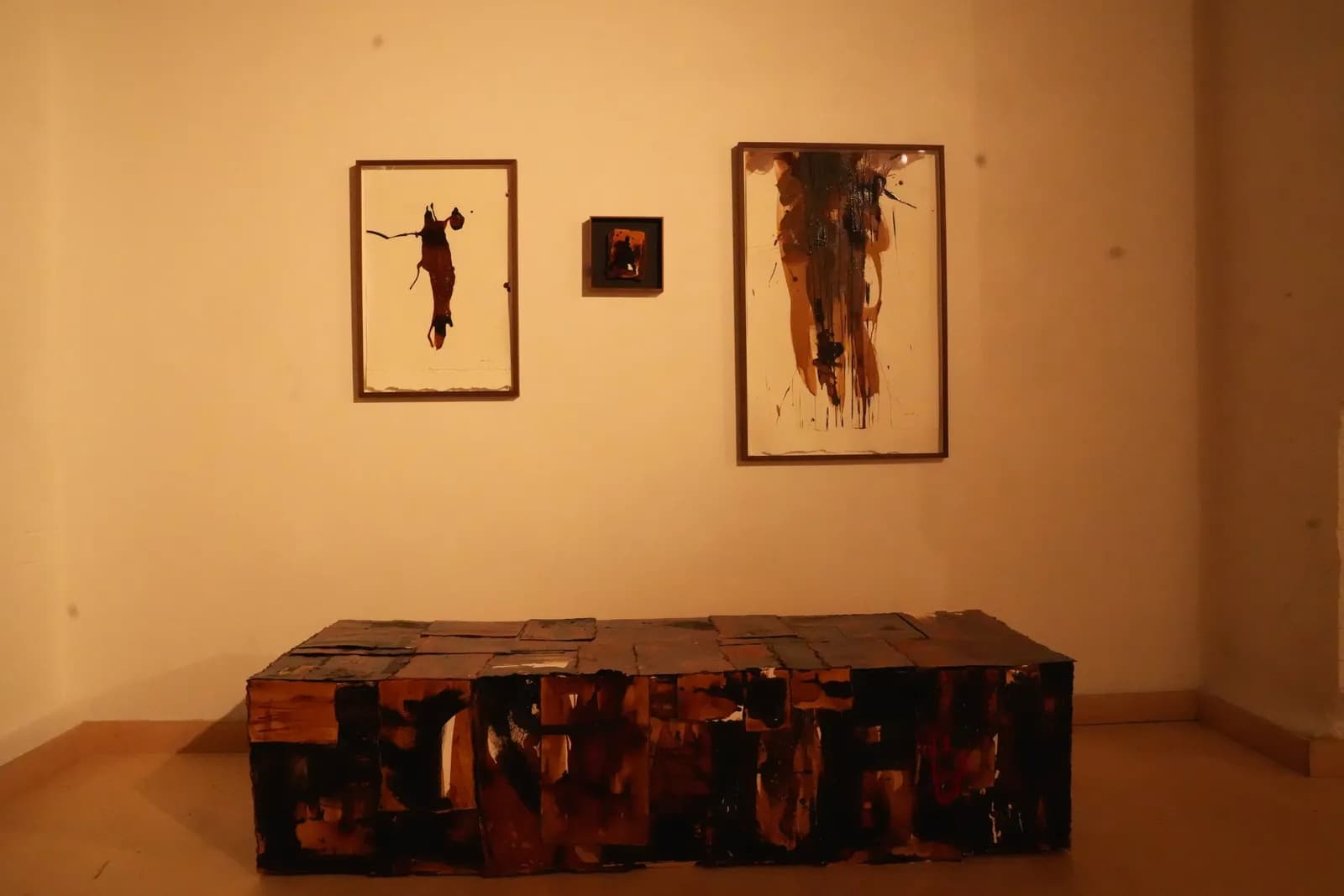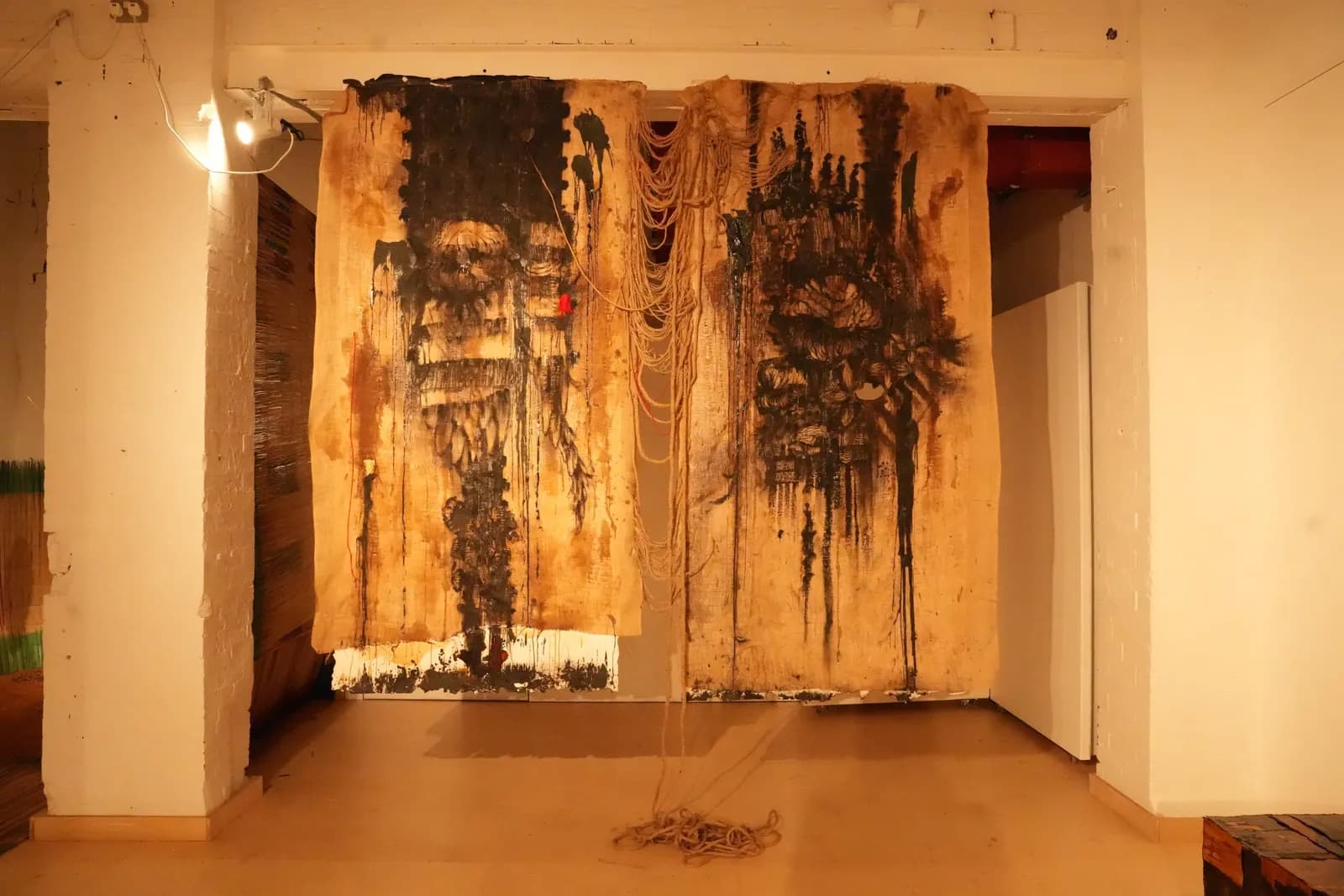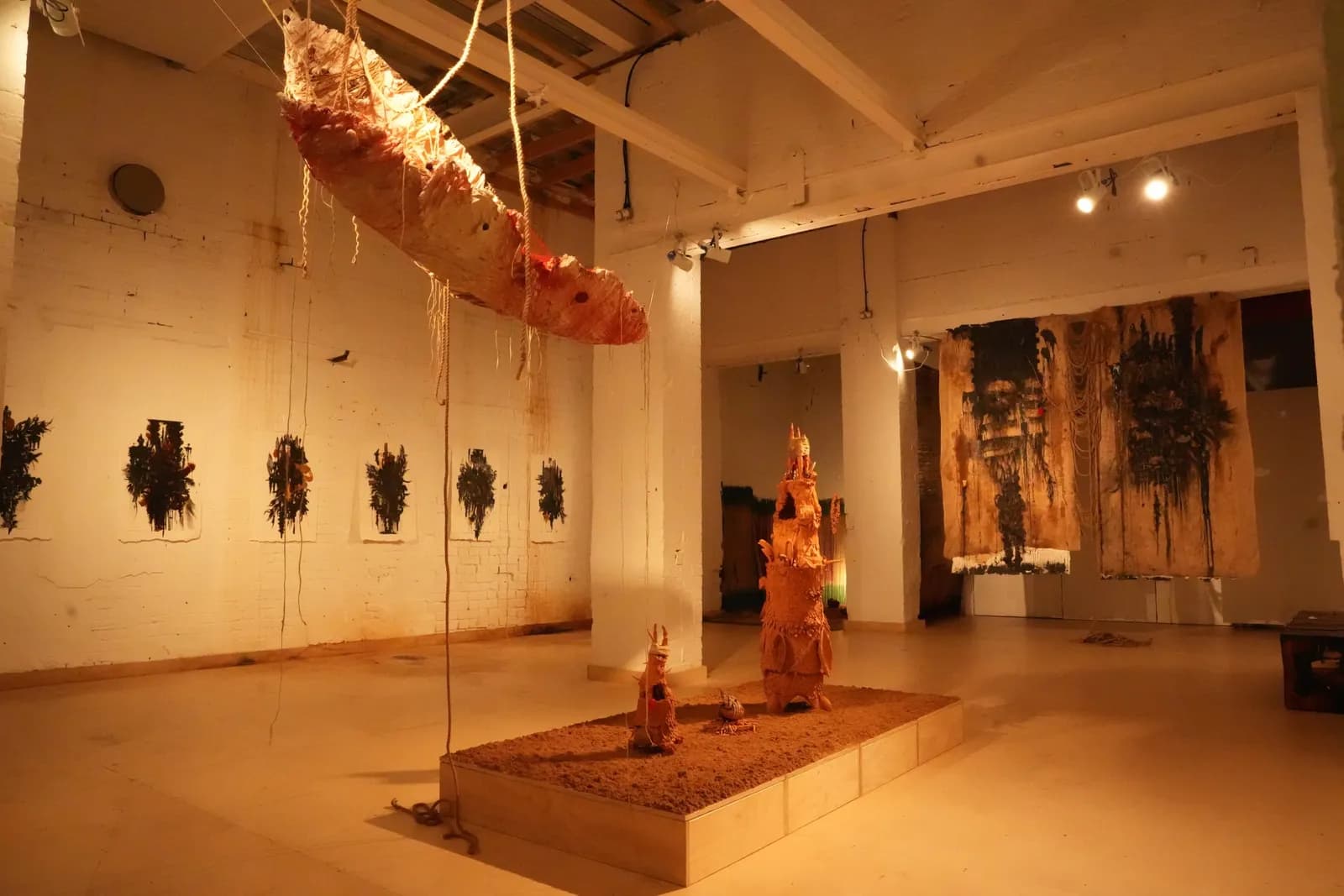
Situated in the Grade II listed building formally used for jewellery manufactory, Birmingham based multidisciplinary artist, Abraham Babajide Cole, opened a solo exhibition entitled The Body as an Archaeological Site at the Hive Gallery this October.
The exhibition brings together drawings, paintings, terracotta sculpture and installation which explore a simple but powerful question: what happens to the body when it enters a new place and begins again?
For Cole, the body is not only a physical form. It holds memory. It records where we have been, what we have inherited and the experiences that change us over time. This idea has become increasingly central to his practice. Drawing from Yoruba cosmology and the idea of the body beyond the physical, Cole’s work looks at movement not simply as travelling from one geography to another, but what happens afterwards: how a person adapts, what remains from a previous place, and how a new environment gradually becomes part of the body itself.
As Cole explained:
“Migration is often described as a journey from one place to another, but I’m interested in what happens after the journey. What do we carry? What do we leave behind? What remains within us, and what do we become? I think of the body almost as an archaeological site because it keeps these traces. Some are visible and some are buried. The work is about trying to understand what we carry through life and how the places we inhabit also begin to live within us.”
While the exhibition is rooted in Cole’s experience as a Nigerian born artist living and working in Britain, it does not attempt to present Black identity as one fixed experience. Instead, it asks how ancestry, memory, spirituality, movement, and place can exist together within a person and how those relationships continue to change and be shaped by the new places and people we encounter.
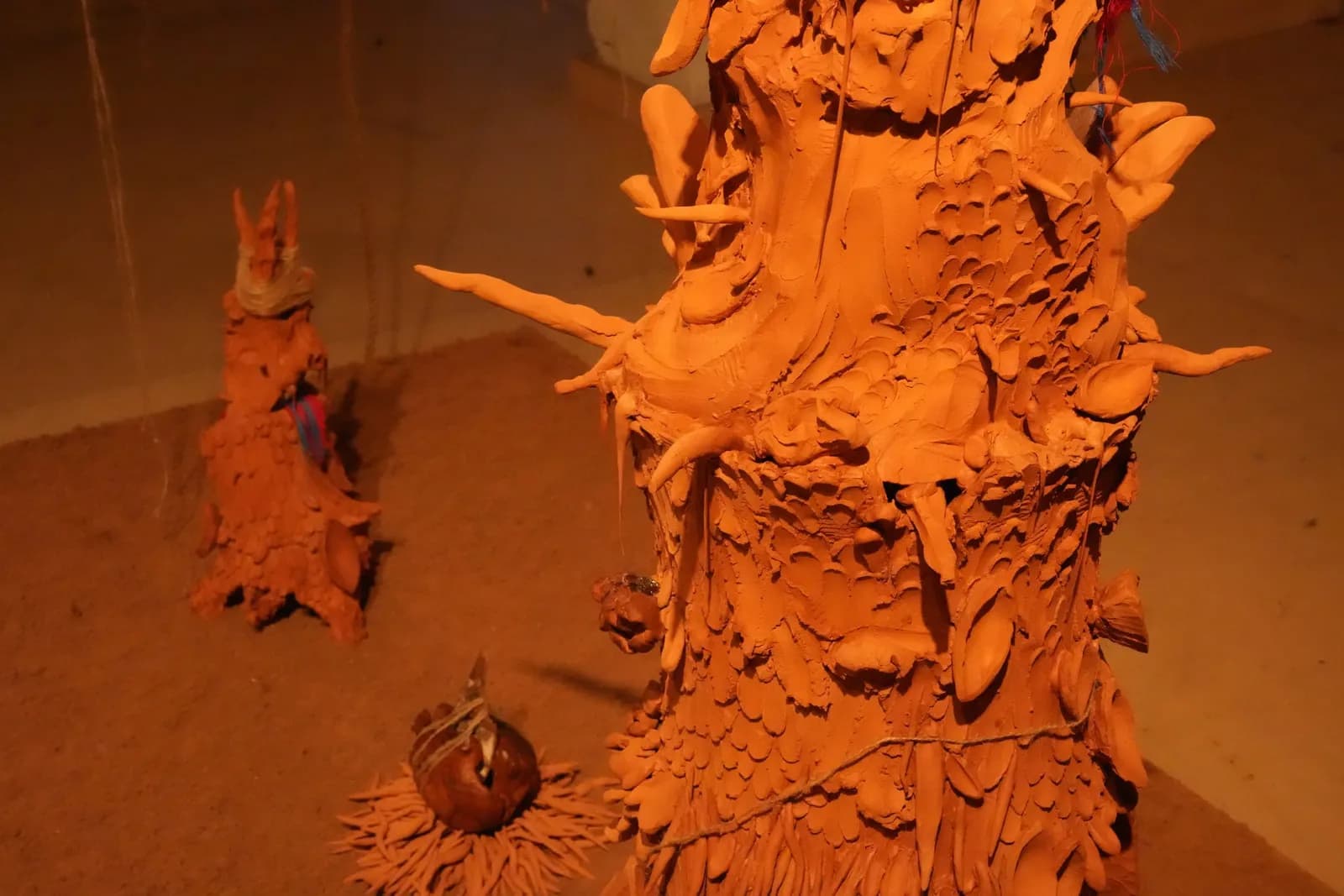
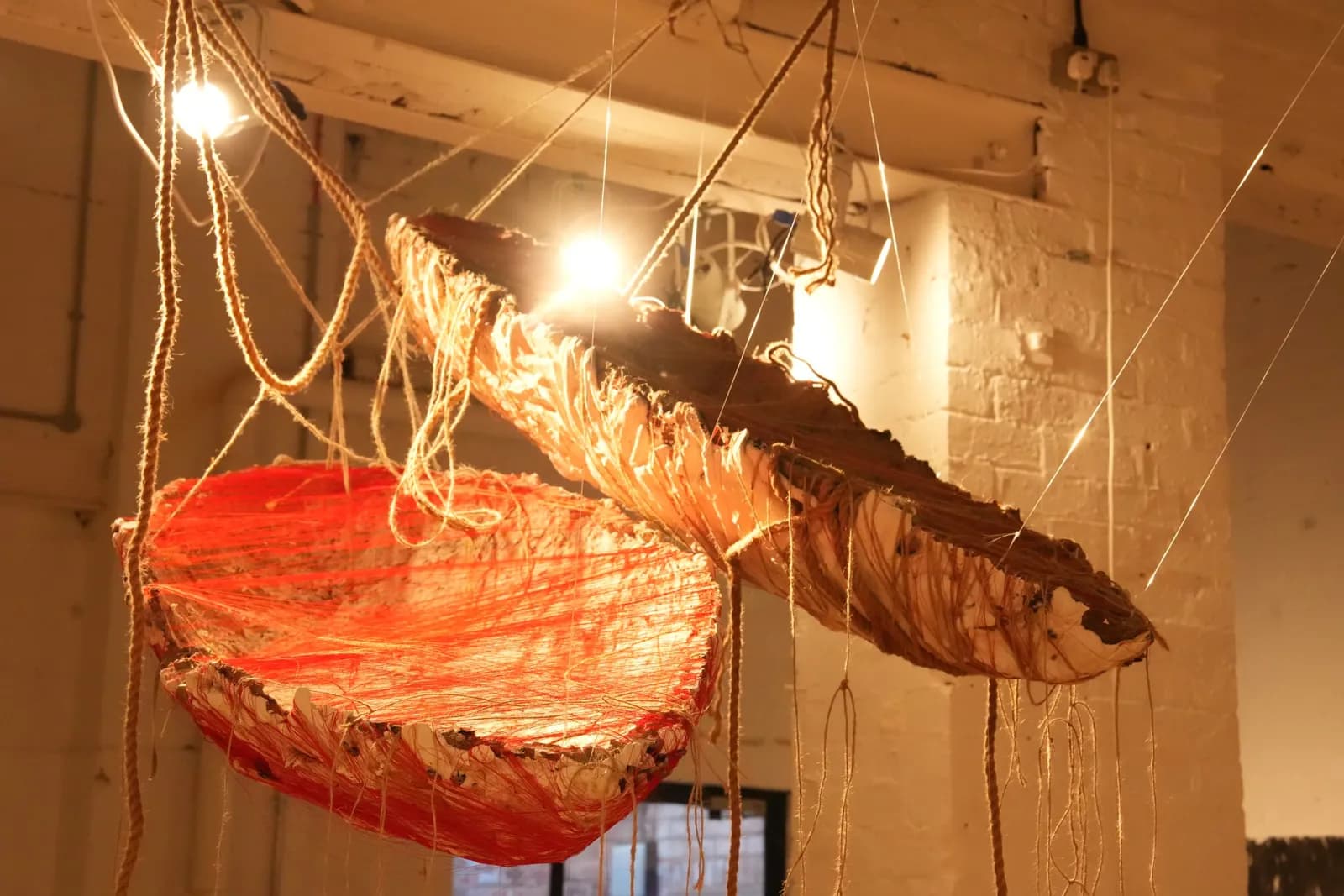
Cole’s artistic language is consistent throughout the exhibition with his use of natural materials including clay, coffee, beeswax, charcoal, fibre, ropes, earth and pigments. Cole choice of materials derives partly from their ability to hold evidence of time and place. Clay keeps the memory and the pressure of the hand, while coffee stains and seeps into the surface. Beeswax can cover, preserve or hold something in place. While rope can unravel and threads can break. These physical qualities of the materials Cole uses in his practice allows the artist to approach memory through making rather than representation; through abstraction rather than illustration. Marks, stains, cracks, impressions and repaired surfaces become part of the work rather than something to conceal.
Especially exciting are Cole’s terracotta sculptural pieces which consist in a large-scale installations with metaphysically inspired sculptures set in dialogue with each other and with two suspended boats. This work, entitled “Elsewhere has Entered the Body”, as well as smaller more intimate installations consisting in boats, Yoruba inspired ikoko pots, clay fragments and a suspended terracotta sculpture set in a shrine-like enclave called “Where the Body Begins”, are just some of the examples of Cole’s ability to move beyond the physical and enter into the realm of the “beyond”. What makes Cole’s work particularly interesting – especially for those interested in art history – are the artist’s (conscious or unconscious) references to the fifteenth and sixteenth century bronze sculptures from the Kingdom of Benin, such as the oba’s beaded regalia and the symbolic motifs alluding to the king’s power, presented in a very contemporary language.
The exhibition was accompanied by a programme of artist-led clay workshops in conversation with the Birmingham community which took place at The Hive Gallery and other local community venues in partnership with ATHAC CIC, a Birmingham community interest company promoting Access to Heritage, Arts and Culture with disabled children, young people and adults. Community participation is indeed a reoccurring theme in Cole’s practice: the clay fragments created by the participants in these workshops were used as part of his installations for the Body As an Archaeological Site.
This exhibition also brings together ideas that Cole has been developing across a number of projects in the West Midlands over the past few years. His solo exhibition Bound by Roots, Divided by Paths at Dudley Library in 2025, explored memory, belonging and the relationship between individual and collective experience. This was followed by a Multistory-supported research commission and residency at Wolverhampton School of Art, before the work developed further through What Grows In Between at The New Art Gallery Walsall in 2026. Cole has recently been awarded another art residency at Birmingham City University for the AA2A cohort of artists for 2026-2027, showing the exponential growth and breadth this artist has made this year, and the exciting new work yet to come from Abraham Babajide Cole in the coming years.